What a Shopify Retainer Should Include (and the Red Flags to Avoid)
E-commerce, Shopify
Nov, 20 2026
What a Shopify Retainer Should Include (and the Red Flags to Avoid)
Most Shopify retainers sell hours. In a typical Shopify monthly retainer you pay a flat fee, get a block of developer time, and hope the tickets get done. At the end of the month you receive a timesheet. The real question is what you get for that money: a more stable store, higher conversion, fewer emergencies, or a pile of closed tasks with no clear link to revenue.
A well-structured retainer shifts the focus from hours consumed to outcomes delivered. It includes defined support, a growth plan, measurable reporting, and an SLA you can hold the agency to. Below: what belongs in a solid retainer, what it costs in 2026, how hour buckets differ from outcome packages, seven red flags, and questions to ask before you sign.
What a Shopify retainer is (and is not)
A Shopify retainer (also sold as a Shopify support retainer or a Shopify maintenance retainer) is an ongoing monthly engagement with a development partner. It reserves capacity for bug fixes, theme and app updates, small improvements, and monitoring, and in stronger packages for conversion work and feature development. The agency already knows your store, your theme, and your app stack, so response times stay short and context is not rebuilt with every ticket.
It is not the same as hourly work. Hourly engagements are transactional: you open a ticket, get an estimate, approve the hours, and wait. There is no reserved capacity and no ongoing ownership of performance. A retainer is also not a fixed-scope project. A project has a start, an end, and a deliverable, such as a redesign, a migration, or a new integration. A retainer is continuous capacity that adapts as your backlog and business change.
Some work is usually excluded: new theme builds and full redesigns, multi-week migrations, net-new integrations beyond a set number of hours, and major headless or custom Functions work. These items are quoted separately, which keeps the monthly fee predictable.
What a good retainer includes
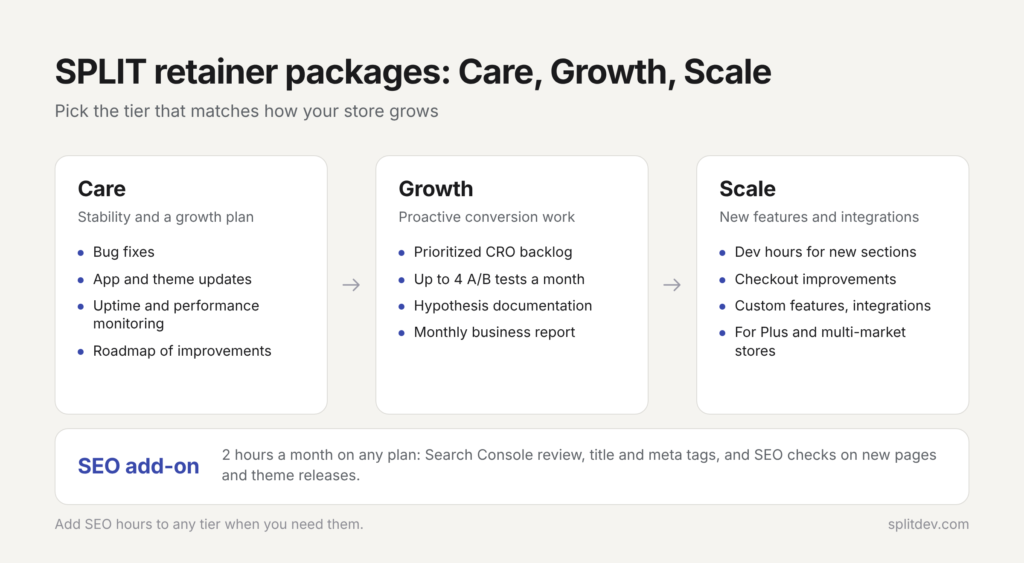
What’s included in a Shopify retainer depends on the tier, but a good one covers more than reactive tickets. The strongest models organize work into clear tiers that match how stores grow. At SPLIT Development, those tiers are Care, Growth and Scale, plus an SEO add-on. You can see how they fit together on our Shopify retainer packages page.
Care: bug fixes, app and theme updates, monitoring
Care is the foundation of any Shopify maintenance retainer. It covers critical and non-critical bug fixes, compatibility checks after Shopify platform updates, theme and app version updates, basic performance and uptime monitoring, and small content or configuration changes. At SPLIT, Care also comes with a quarterly roadmap of five improvements, each with estimated impact and hours, so the retainer is not purely reactive. The goal is stability: the store stays online, checkout works, and known issues do not linger for weeks.
Growth: A/B tests, CRO backlog, business reporting
Growth adds proactive work. Typical inclusions are a prioritized CRO backlog, a set number of A/B tests per month (up to four in our package, set to match your traffic), and hypothesis documentation. A monthly report ties the work to conversion rate, revenue per visitor, and other business metrics. The agency proposes tests instead of only executing the tickets you submit. On two of our client stores, moving the star rating under the product title lifted conversion by 9.7%, and swapping a shade dropdown for swatches lifted it by 11.2%, as reported by the brands.
We start A/B testing from about 10,000 sessions a month. Confirming even a large lift within a month takes closer to 40,000 sessions on the tested page, so smaller stores run fewer, bolder tests. A Shopify CRO audit (delivered in about three business days) is a good starting point, because it gives the backlog its first priorities. Here is how we run A/B tests, including how much traffic a test needs to prove a given lift.
Scale: dev hours for new features and integrations
Scale reserves development capacity for new sections, checkout improvements, custom functionality, and integrations. Hours are still tracked here, but the conversation centers on the roadmap rather than how many hours are left. At SPLIT, Scale runs in two-week sprints with a demo at the end of each. The tier suits Shopify Plus stores and multi-market setups that ship features regularly. If you run Plus, see how we approach Shopify Plus development, including ongoing support after launch.
Add-ons: SEO hours
The SEO add-on is a small fixed block of two hours a month that works on any plan. At SPLIT it covers a monthly Search Console review, a five-step plan, and title and meta tags for five pages. It also includes a check of one new page before it goes live and an SEO check after every theme release (noindex, canonical, and redirects). It works best when the team that knows your theme ships the changes.
Response times: what an SLA should spell out
A usable service level agreement defines priority levels and response targets in hours. Targets depend on the tier, so compare plans at the same price point. A typical structure looks like this:
Critical (store down, checkout broken, payment failures): handled immediately on every plan, outside the normal queue.
High priority (broken functionality, integration errors, performance problems that affect revenue): from about 4 hours on premium plans to 24 hours on mid-tier plans.
Normal requests (design updates, content changes, small features, optimization tasks): typically 12 to 48 hours, depending on the tier.
Response time is not resolution time, so ask for both. Coverage windows matter as well. Business-hours SLAs are standard for most stores, but the contract should name the time zone. 24/7 or after-hours coverage suits high-revenue and flash-sale merchants and is usually priced as a higher tier. The SLA should also say how priorities are assigned and what happens when the agency misses a target. At SPLIT Development, critical issues are picked up right away on every plan, and the first response on other requests takes 48 hours on Care, 24 on Growth and 12 on Scale, on working days.
What Shopify retainers cost in 2026
Shopify retainer cost in 2026 ranges from about $900 to $10,000 or more per month, depending on hours, SLA, and team seniority. Some agencies publish hour-based packages that start at about $900 for 15 hours and reach about $2,000 for 40 hours, with blocks of 60 or more hours starting near $2,700. That works out to roughly $45–$60 per hour.
Agency cost guides put ongoing retainers for active stores at roughly $2,000–$10,000 or more per month. Shopify Plus and multi-store engagements with dedicated capacity and tight SLAs sit toward the top.
Packages built around outcomes price the value of the roadmap and reporting, not just hours multiplied by a rate. At SPLIT, Care starts at $500 per month, Growth at $1,400, and Scale from $2,100, with a $70 SEO add-on. Compare scoped proposals, not starting prices.
Hours vs outcomes: what you are actually paying for
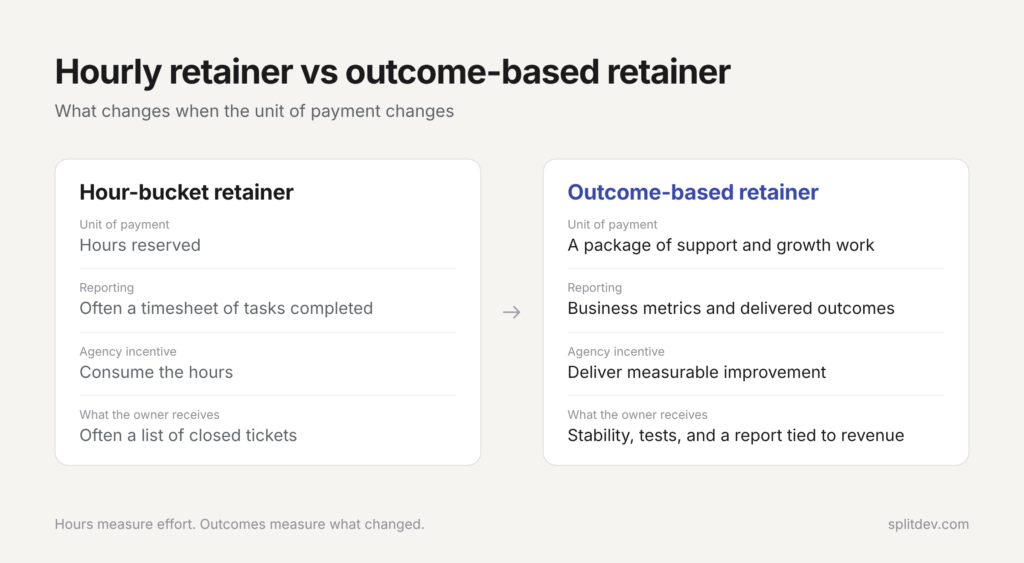
Hour buckets are a reasonable way to buy capacity, but they create the wrong incentives. The agency is paid for time spent, not results achieved, and the merchant receives a timesheet instead of a picture of business impact. Quiet months waste paid capacity, and busy months force prioritization fights or extra invoices. There is not always a shared plan that ties the work to conversion, AOV, or operational stability. This happens without any bad intent, because the unit of payment rewards time spent.
Outcome-based packages flip the model. The monthly fee buys defined support capacity plus a growth plan, a backlog, tests, and reporting tied to the metrics the merchant cares about. Hours still define the capacity of each package, but the monthly conversation with the client is about results.
Aspect
Hour-bucket retainer
Outcome-based retainer
Unit of payment
Hours reserved
Package of support + growth work
Reporting
Often a timesheet of tasks completed
Business metrics + delivered outcomes
Agency incentive
Consume the hours
Deliver measurable improvement
Planning
Often reactive tickets
Shared backlog and monthly priorities
What the owner receives
Often a list of closed tickets
Stability + tests + report tied to revenue
Unused capacity
Often expires
Work is planned so capacity is used productively
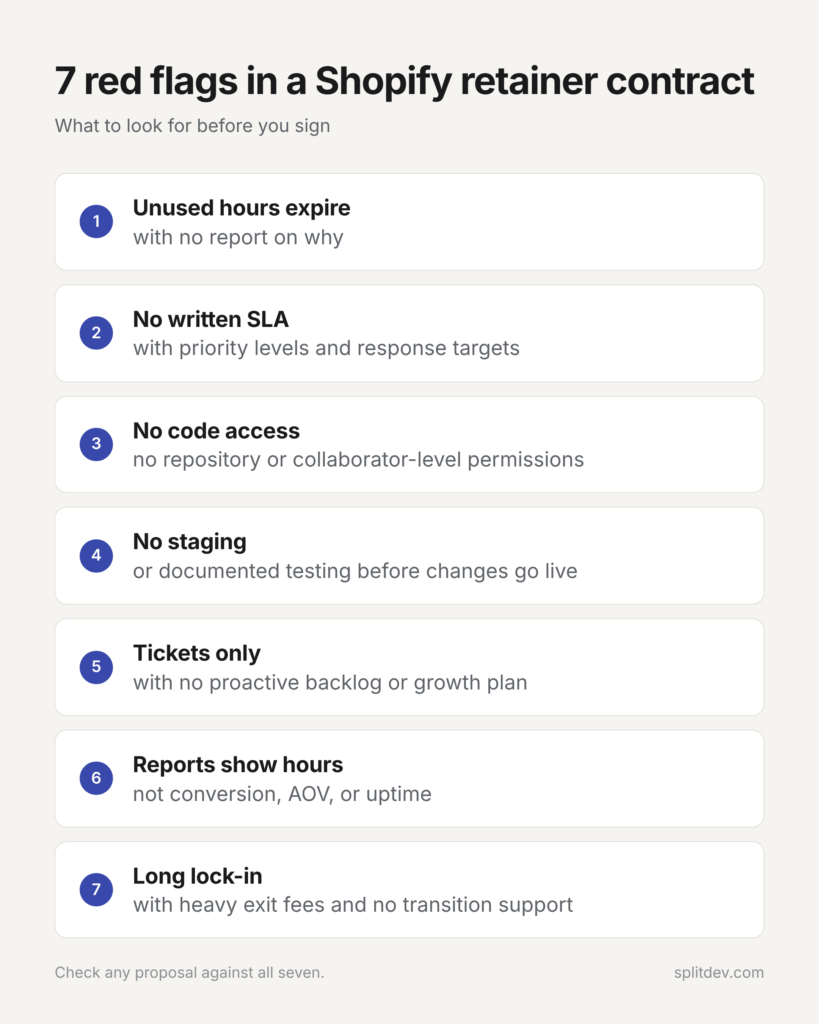
7 red flags in a Shopify retainer contract
Check any proposal against these seven red flags before you sign.
Unused hours expire with no report on how capacity was planned or why it went unused.
There is no written SLA with priority definitions and response targets.
You get no access to the code repository or collaborator-level permissions, and the agency works only through the admin or a black-box process.
There is no staging environment or documented testing process before changes go live.
Work is limited to tickets you submit, with no proactive backlog or growth plan.
Monthly reports show hours spent instead of business metrics such as conversion, AOV, cart abandonment, Core Web Vitals, and uptime.
Lock-in periods are long, with heavy early-termination fees and no clear exit or transition support.
Questions to ask before you sign
Before you choose a Shopify retainer agency, ask these questions in writing. The answers show whether you are buying hours or results.
What exactly is included, and what is always quoted separately?
What are the priority levels, and what are the response and resolution targets for each?
How is unused capacity handled, and does anything roll over?
Who does the work: senior developers, a mixed team, or junior resources?
Will we have repository access and a staging environment?
What does the monthly report contain, hours or business metrics?
What is the notice period, and how does the exit process work?
How do you prioritize the backlog when bugs and growth work arrive in the same month?
Can we see an example monthly report and a sample A/B test hypothesis from a similar store?
What a month with a retainer looks like
At SPLIT, a month runs in four weeks: review, design and build, launch, then a report and a 30-minute call. In a retainer built around outcomes, the owner should find the same artifacts at the end of every month:
A one-page report sent before the call: conversion rate, AOV, and revenue per visitor, plus uptime, tasks done, what was fixed, hours used, and what is next.
Test results: which A/B tests ran, the hypothesis behind each, and the effect on conversion and revenue per visitor.
An updated backlog: what is next, in what order, and why.
A call: 30 minutes on what worked and what comes next.
One example of this model in practice is Meroda Cosmetics, a Dutch DTC beauty brand on Shopify Plus. SPLIT Development consolidated nine Shopify Plus stores into five (EU, NL, IT, DE and CH), rebuilt the storefront on Online Store 2.0 with design by Meroda’s team, and supports the stores on an ongoing basis, including cart and checkout improvements. Meroda reported that average order value rose 22% and abandoned carts fell 31%. A retainer should be judged on numbers like these.
A good Shopify retainer leaves you with a store that breaks less often and a monthly report that shows whether the work moved revenue. If a proposal promises only hours and a timesheet, keep looking.
Choose a package: Care (support plus a growth plan), Growth (up to four A/B tests a month plus reporting), Scale (development hours), or the SEO add-on (two hours). Compare retainer packages
FAQ
How much does a Shopify retainer cost per month?
Most Shopify retainers cost between about $900 and $10,000 or more per month in 2026. Some agencies list hour-based packages starting near $900 for 15 hours, while active stores often pay $2,000–$10,000 or more depending on hours, SLA, and team seniority. At SPLIT, packages start at $500 per month. Ask for a scoped proposal rather than comparing starting prices alone.
What is included in a Shopify retainer?
A Shopify retainer typically includes bug fixes, theme and app updates, monitoring, and small improvements, with conversion work, reporting, and development hours in higher tiers. Large redesigns, migrations, and complex integrations are usually quoted separately. Ask for the inclusions and exclusions in writing, along with the SLA that covers them.
How many hours per month do I need?
Agencies commonly size retainers at about 10–40 hours per month for standard stores, 40–80 for growing Shopify Plus stores, and 80 or more for large enterprise setups. Complexity drives the number more than revenue: custom features, multiple markets, and frequent releases all raise it. To estimate your own, list the fixes, updates, and tests you expect each month and size the retainer to that list.
Do unused retainer hours roll over?
Usually not. Many hour-based retainers expire unused hours at the end of the month, though some agencies allow limited rollover or top-ups. At SPLIT, unused hours roll over once, to the next month. Outcome-based packages reduce the problem by planning work against a backlog. Get the rule in writing before you sign.
What is the difference between a Shopify retainer and hourly work?
A retainer reserves ongoing capacity and usually includes an SLA, shared context, and, in stronger packages, a growth plan. Hourly work is transactional: each request is scoped and approved separately, with no guaranteed response window and no carried-over knowledge of your store.
Can I cancel a Shopify retainer?
Yes, most retainers can be canceled, typically with about 30 days’ notice on month-to-month plans. At SPLIT there is no minimum term, and you can switch plans or stop from the next month. Long lock-ins with heavy early-termination fees are a red flag. Confirm the notice period and what transition support you get for code and documentation.