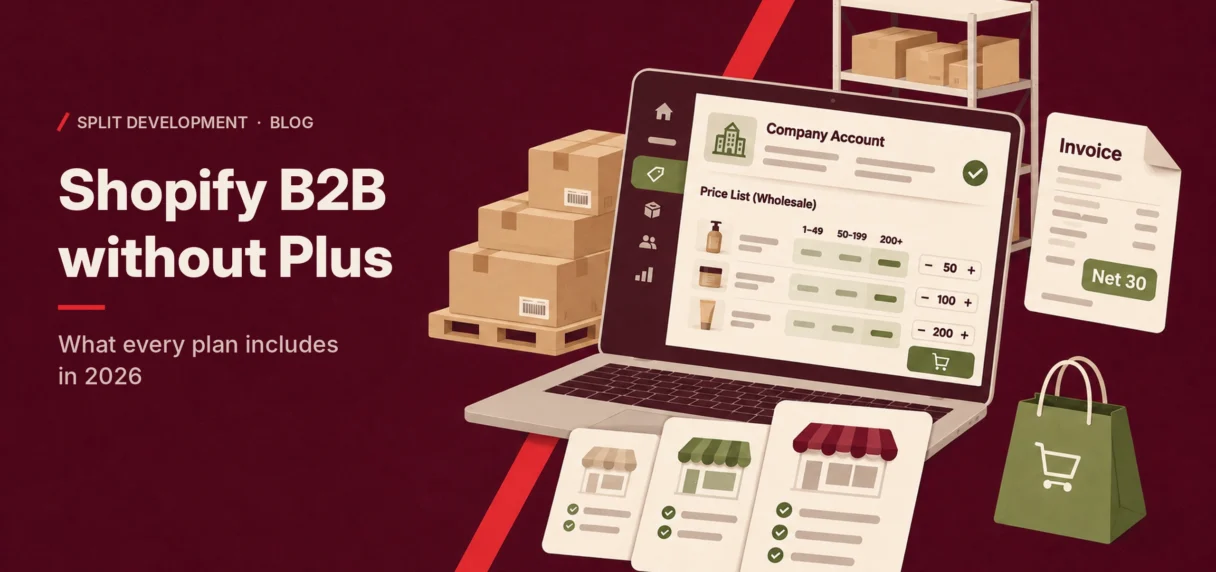
Shopify for B2B no longer means you have to be on Shopify Plus. Since April 2, 2026, native B2B runs on the Basic, Grow and Advanced plans at no extra cost. The question has moved from “can I sell wholesale on Shopify” to “how much complexity will my current plan actually hold”.
This article is for DTC brands that want to open a wholesale channel on the same store, and for wholesalers deciding whether Shopify Plus is required for their pricing and ordering rules. We cover what is available on every plan, what stays Plus-only, and where native features stop being enough, based on our Shopify B2B development work.
What native Shopify B2B includes on every plan
On Basic, Grow, Advanced and Shopify Plus you get the same core B2B tools, according to Shopify’s B2B features by plan. You can create companies with multiple locations and buyers, assign location-level permissions, and let trade customers order for themselves.
Catalogs let you set custom prices (percentage adjustments or fixed prices) and control which products each group sees. Quantity rules (minimum, maximum, increment) and quantity price breaks are included. Net payment terms, payment reminders, ACH (United States only) and vaulted credit cards are available. Buyers can place orders themselves, use a quick order list, reorder from history, and add PO numbers. The Trade theme is available, and Shopify Flow works with B2B objects.
These features are included in the plan price. There is no separate B2B fee.
Shopify Plus B2B features you only get on Plus
Shopify Plus removes the main ceilings and adds payment controls that matter for larger wholesale operations.
On Plus you get unlimited active catalog assignments across B2B markets. You can also assign catalogs directly to individual companies or company locations, which is how customer-specific pricing works. Deposits, partial payments and payment requests per fulfillment are Plus-only.
Contextual storefront and checkout (via Shopify Markets) is available from Advanced upward, so Advanced merchants can already tailor the experience by market. For most brands that need per-company price lists or advanced payment terms, Plus is the practical requirement.
If you need these capabilities, our Shopify Plus development work covers the configuration and any custom logic around them.
Shopify B2B without Plus: where the three-catalog limit bites
On Basic, Grow and Advanced you can have up to three active catalog assignments across all your B2B markets. The limit is store-wide. Assigning the same catalog to two markets counts as two assignments. You also need the new version of Shopify Markets to use catalog features on these plans.
This limit is usually the first real constraint. A brand that sells to different regions and also wants separate pricing for retailers, distributors and key accounts hits the three-catalog ceiling faster than expected. Once you need a fourth price list, or you want to give one company its own catalog, the non-Plus plans stop being sufficient.
At that point the practical options are moving to Shopify Plus, extending the setup with a wholesale app, or building custom logic.
When a wholesale app or custom build still makes sense
Native B2B covers company accounts, catalogs, quantity rules and net terms for many first wholesale programs. It does not cover every commercial rule.
A wholesale app or custom development still makes sense when you need complex approval flows for new trade accounts, multi-level pricing that cannot be expressed in three catalogs, different MOQ rules by customer or product group, or tight two-way sync with an ERP or PIM. Request-for-quote workflows and certain contract pricing models also sit outside native features.
Apps exist for these gaps. We do not rank them here. When the requirement is unique enough that an app would need heavy customization, a custom Shopify app or direct development is often cleaner.
What happened to the Shopify wholesale channel
The old Shopify Plus Wholesale Channel, a separate password-protected storefront, was retired in 2024. Shopify replaced it with the native B2B features that now run inside the main store and admin. There is no longer a separate channel to install.
What does not work with Shopify B2B
Several features are incompatible with B2B orders:
- Accelerated checkouts (Shop Pay, Apple Pay, Google Pay, Amazon Pay)
- Local delivery
- Pickup points
- Tipping
- Subscriptions
- Legacy customer accounts
If your brand sells subscriptions, a B2B order and a subscription cannot be combined in the same checkout. Brands that need both channels usually keep subscriptions on the DTC side and handle wholesale as a separate flow.
Running B2B and DTC in one store
You can run B2B and DTC from one Shopify store (a blended store). One catalog and one inventory serve both channels. Retail shoppers see retail prices and the standard experience. Logged-in trade buyers see their assigned catalog, pricing and terms.
Most settings apply to both channels. Some (certain discounts and payment methods) can be configured separately. This model avoids the cost and complexity of running two stores and syncing inventory between them. It works well when your trade customers and retail customers largely buy the same products.
How much Shopify B2B costs
Native Shopify B2B has no additional fee on Basic, Grow, Advanced or Plus. The real costs are the difference in plan price, any apps you add, and the development or integration work required to match your commercial rules.
Plan prices change and are listed on Shopify’s pricing page. For implementation, our Shopify Plus development work starts from $12,000. B2B projects start from $10,000. The final number depends on the number of price lists, the approval and ordering flows you need, and whether we are connecting an ERP or migrating existing wholesale data.
How to choose: a quick decision guide
- You have one or two clear trade tiers and three price lists or fewer: start on Basic, Grow or Advanced with native B2B.
- You need customer-specific catalogs, unlimited price lists, or deposits and partial payments: move to Shopify Plus.
- Your approval flows, quote process or pricing rules sit outside native catalogs: add a wholesale app or plan a custom build.
- You are moving an existing B2B operation from another platform: factor in data mapping for company accounts and customer-specific pricing as part of the project. We handle migrating B2B to Shopify and also cover moving from BigCommerce.
- You already run a high-volume DTC store and want to add wholesale without breaking retail conversion: a blended store on the right plan is usually the cleanest path.
If you are deciding how to launch or expand wholesale on Shopify, our B2B team can map what native features cover for your rules and where an app or custom work is required. We recently built company accounts, B2B catalogs and Catalog API pricing for a European fashion wholesaler on Shopify Plus, moving them from email orders to self-serve in ten weeks.