What the Best Shopify Beauty Stores Do Differently
E-commerce, Shopify
Oct, 15 2026
What the Best Shopify Beauty Stores Do Differently
The best Shopify beauty stores are built around one problem most stores never face: the shopper can’t touch, swatch or smell anything before paying. Every pattern in this article is a way to close that gap online.
That gap matters more each year. E-commerce holds 28% of global beauty sales and is already the largest channel, ahead of grocery at 19% and specialty beauty stores at 18%, according to McKinsey’s 2026 State of Beauty report. McKinsey expects e-commerce to account for most of the category’s growth through 2030, as the market grows about 5% a year to $590 billion.
We build Shopify stores for beauty brands at SPLIT Development, so we read these stores the way a developer would. We look at what sits on the collection page, what the product page explains and what happens after the first order.
How We Picked the Best Shopify Beauty Stores
Most lists of beauty ecommerce design examples rank stores by how they look. We picked these by how their stores work. Every store here runs on Shopify, confirmed by a Shopify case study or by our own build. Every result we cite was published by the brand, by Shopify or by us.
That left four well-known brands and one SPLIT client:
Murad, for product discovery and ingredient education
Rare Beauty and Glossier, for sampling and launch mechanics
Dermalogica, for speed after a theme change
Suntouched, a SPLIT build, for theme structure
The article is grouped by pattern, and each store appears where it shows one best. Shoppers don’t experience a store as a brand story. They meet a filter, a product page, a review block and a checkout, and each one either answers their question or sends them elsewhere. Four more SPLIT Development builds in beauty and wellness follow in a shorter list near the end.
Shade, Skin Type and Concern: Navigation That Matches How People Shop
Beauty shoppers rarely browse by product type first. They arrive with a skin type, a concern or a shade range, and a catalog sorted only into “Serums” and “Moisturizers” makes them do the matching themselves.
Filtering is where many stores lose them. Baymard Institute’s UX benchmark finds that 34% of sites tested filter so poorly that narrowing a list to suitable products is close to impossible (Baymard). In its 2015 benchmark of 50 major US sites, only 16% offered a good filtering experience.
The same 2015 benchmark found that 42% of major sites lacked category-specific filters for several core product verticals (Baymard). In beauty, those are filters by skin type, concern, finish, coverage and undertone, built from product data rather than typed into tags by hand.
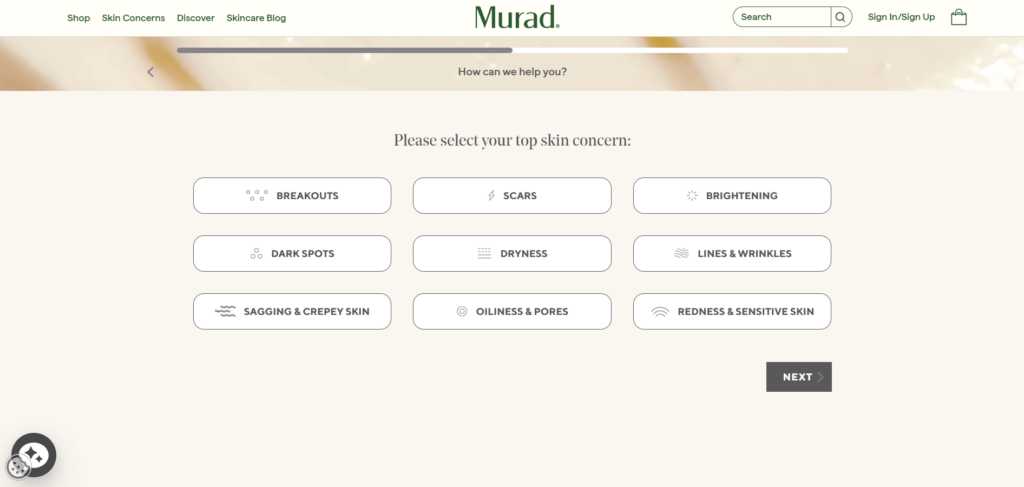
When the right product depends on several attributes at once, the strongest stores add a guided path. Murad uses an AI-powered quiz that matches shoppers to products by skin concern (Shopify case study).
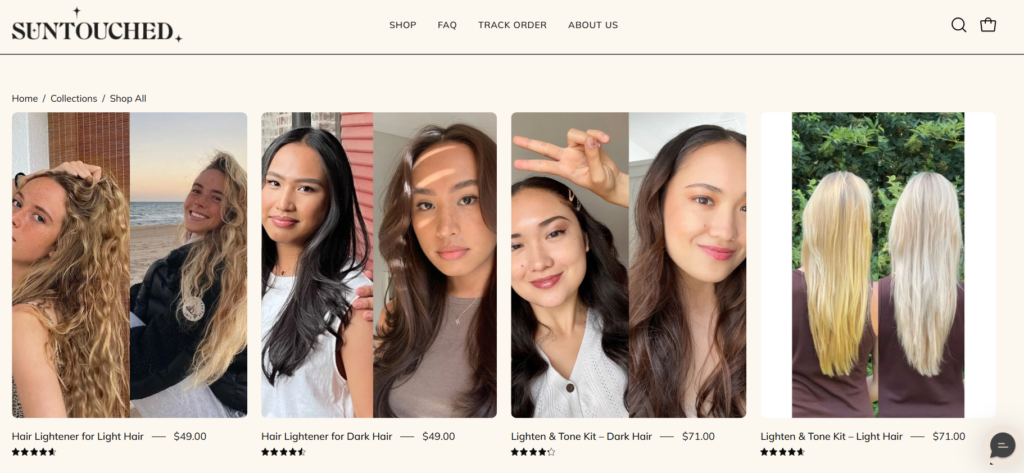
Navigation also depends on what the theme allows. Suntouched, a Canadian haircare brand, came to us from a basic site builder that limited how products and navigation could be presented. Our SEO audit shaped the site structure first, then we designed and built a custom Shopify 2.0 theme from scratch around the brand’s catalog. Charlotte, the store owner, reports that conversion rose 45% after the new site went live (see the Suntouched build).
Suntouched’s collection page on its custom Shopify 2.0 theme
What to take from this:
Store skin type, concern and shade family in metafields, so filters and quizzes read from one source
Promote the two or three most important filters above the product grid, a nudge only 16% of major sites used in Baymard’s 2015 benchmark
Add a quiz when the right product depends on more than two attributes at once
The Education Problem on a Beauty PDP
A beauty product page has to sell something the shopper can’t test, and its main tool is explanation. The hard part is explaining enough to earn trust without burying the add-to-cart button.
Trust in ingredient claims is low. Mintel’s 2025 UK research found that 72% of facial skincare users think brands use ingredients to push products people don’t need, and its analysts point to brands elevating a few hero actives in response (Mintel).
Murad builds education into the buying path. In the year after the skincare brand moved to Shopify from Adobe Commerce, its conversion rate rose 56% and average order value rose 17% (Shopify case study). The case study points to a smoother checkout and stronger education throughout the journey, with the quiz and detailed product pages helping shoppers understand their skin needs.
Murad’s quiz routes shoppers to products by skin concern
Ingredients Without the Wall of Text
The common failure is a full INCI list pasted under the description. It is accurate and almost useless to a shopper scanning the page on a phone.
Stores that handle this well split ingredient content into layers:
A short key ingredients block with three or four hero actives and what each one does
Concentration or proof where it exists, such as a percentage or a clinical result
The full ingredient list in a collapsed tab for shoppers checking for specific allergens
Skin type and concern tags that match the filters on the collection page
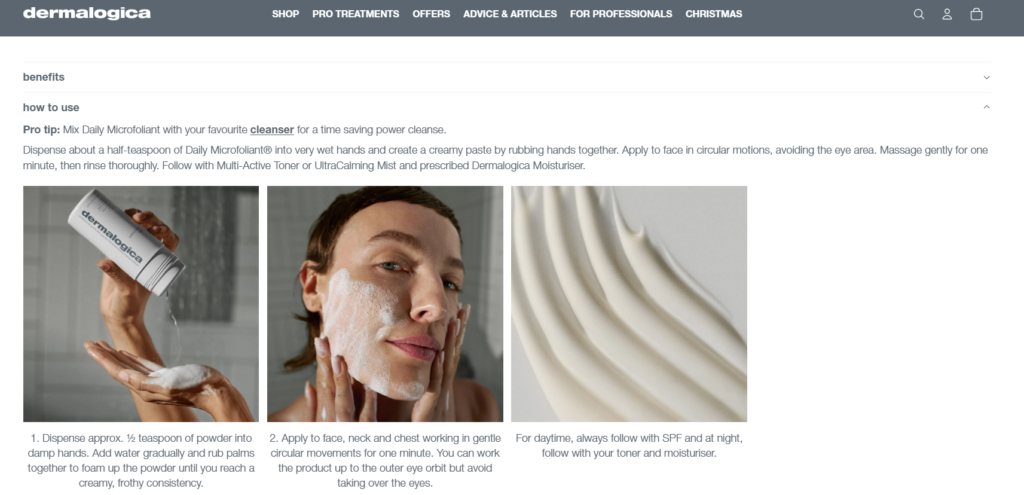
On Shopify, each layer works best as a structured metafield rendered by the theme. Dermalogica’s four-step “how to use” guide on its product pages, for example, now comes from a metafield instead of custom template code (Shopify case study). The same data can feed filters, comparison tables and search. For the design side of these blocks, see our guide to designing beauty product pages on Shopify.
Dermalogica’s product page with a how-to-use block
Structured product data also matters outside the store. McKinsey estimates that AI platforms could drive up to 35% of e-commerce transactions within three to five years. It advises beauty brands to structure product content across ingredients, benefits, clinical validation and use occasions so AI systems can interpret and recommend it (McKinsey).
Sampling, Bundles and Subscription Mechanics
Sampling replaces the counter test online, and the top Shopify beauty stores use it as a launch tool.
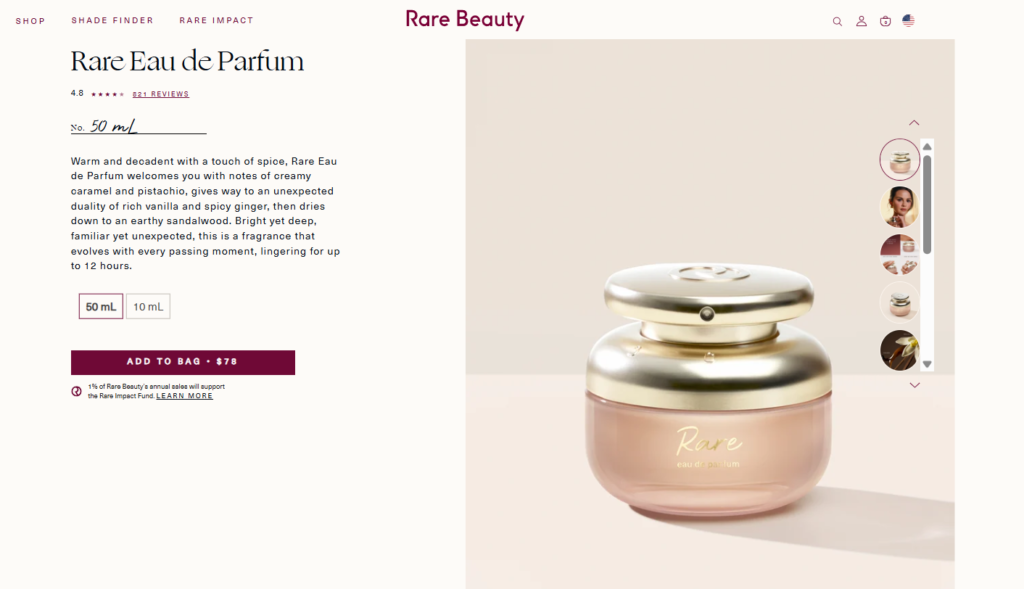
Rare Beauty introduced its first fine fragrance with scratch-and-sniff billboards at street level around New York City. Shoppers scanned a QR code and ordered an exclusive pre-launch sample through Shopify’s Shop app before the scent went live on the brand’s site (Shopify case study). The brand’s VP of consumer marketing describes sampling as key to purchase.
Rare Beauty sampled its first fragrance through the Shop app before launch
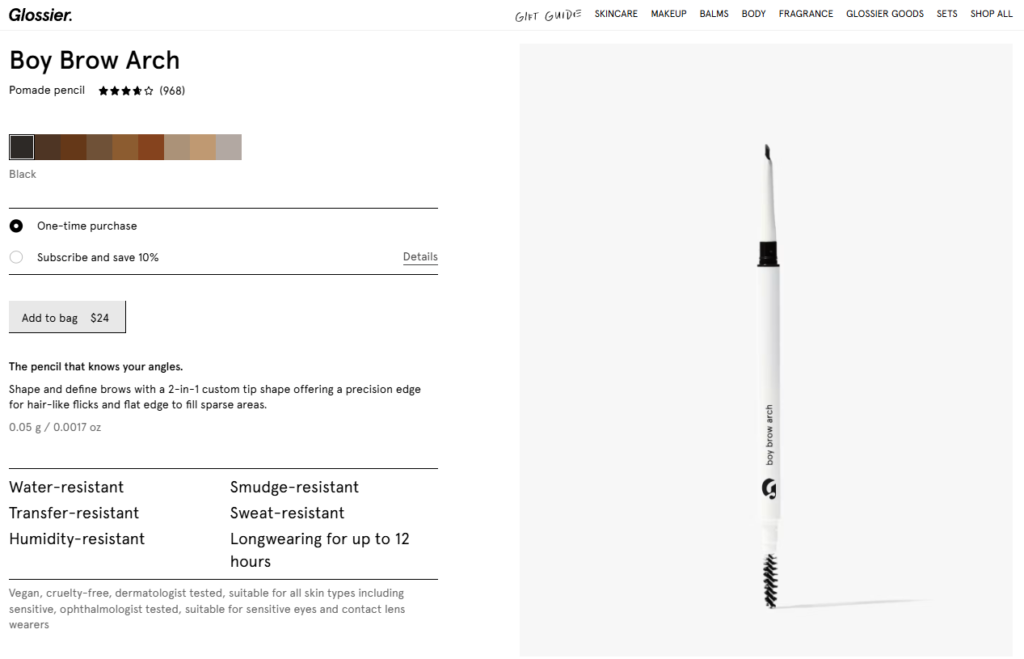
Glossier used a similar mechanic for a brow product. Posters in New York, Chicago and Los Angeles let fans within local range buy Boy Brow Arch through the Shop app ahead of its launch on Glossier.com (Shopify case study).
Glossier opened Boy Brow Arch to local fans through the Shop app before launch
Bundles do similar work on price. McKinsey points to exclusive sizes, kits and product bundles as ways to make a beauty brand more accessible without undermining its equity (McKinsey).
Subscriptions handle what comes after the first order. Most beauty products run out on a predictable cycle, which makes replenishment a natural fit. In 2022 data from more than 15,000 subscription merchants, Recharge, a subscription platform, found that merchants kept 45% of subscribers after six months and 33% after twelve (Recharge). Beauty and personal care merchants had the lowest customer churn of any vertical in that data.
Patterns to check on your own store:
Subscribe-and-save sits on the product page next to one-time purchase, with the delivery cadence stated
Starter sets, minis or kits give a low-risk first order
Subscribers can skip, swap or pause without contacting support
Reviews and User Content That Earn Trust
Reviews do the job a sales associate does in store, and the effect starts early. Northwestern University’s Spiegel Research Center found that purchase likelihood for a product with five reviews is 270% higher than for one with none (Spiegel Research Center). For higher-priced products, displaying reviews lifted conversion 380%, against 190% for lower-priced ones.
More reviews help only up to a point. The benefit of each additional review drops quickly after the first five, and purchase likelihood typically peaks at ratings between 4.0 and 4.7 stars, then falls as ratings approach 5.0. Spiegel recommends embracing negative reviews, since they make the rest look credible.
In beauty, the most useful reviews carry context the shopper can match to themselves:
Skin type, skin tone or hair type of the reviewer, as structured fields
Customer photos on the specific shade or variant, not only on the product
Verified buyer badges, which Spiegel found improve the odds of purchase by 15%
Visible critical reviews with a reply from the brand
The research was first published in 2017, so treat the exact percentages as directional.
Speed on Image-Heavy Catalogs
Beauty catalogs are image-heavy by nature: swatches, textures, before-and-after shots and model photos for every shade. Each image is a reason to buy and a cost to load.
That cost shows up in conversion. In a study commissioned by Google and run by 55 and Deloitte across 37 brand sites, a 0.1-second improvement in four mobile speed metrics lifted retail conversion rates by 8.4% (web.dev). Progression from product page to add-to-basket rose 9.1%, and retail shoppers spent 9.2% more. The data was collected at the end of 2019.
Dermalogica shows what a theme decision can do. By early 2025 the skincare brand’s theme, built on Shopify’s Dawn foundation, had become 60% custom code. It moved to Shopify’s Horizon theme foundation in September 2025 and compared 30-day averages before and after launch. Conversion rate rose 9%, Largest Contentful Paint improved 12%, Interaction to Next Paint improved 15% and Cumulative Layout Shift fell to 0.01 (Shopify case study). It also replaced separate subscriptions for personalization, search and page building with native theme features. If you are weighing a similar move, we compare premium themes and custom builds for growing DTC brands.
Google rates an LCP of 2.5 seconds or less as good, measured at the 75th percentile of page loads (web.dev). On a beauty product page, the LCP element is usually the hero image, so that one image largely decides the score.
What fast beauty stores do:
Serve the hero image at the displayed size in a modern format through Shopify’s image CDN, and lazy-load gallery images below it
Keep shade swatches as small images or CSS colors, not full product photos
Audit apps regularly, since reviews, quizzes and subscription widgets each add scripts
Reserve space for images and widgets so the layout doesn’t shift while the page loads
More Shopify Beauty Stores Worth Studying
The five stores above have public case studies from Shopify or from us. The four below are also SPLIT Development builds in beauty and wellness, and each one solved a different problem you can see on the live store.
PetaJane: A Self-Tan Store Built on Dawn
PetaJane is a US self-tanning brand founded by Peta Murgatroyd. SPLIT Development designed and built its Shopify store on a customized Dawn theme, with conversion-focused product pages for a formula that both colors and nourishes skin, and also handles growth and SEO for the brand. Conversion rose 4.5% after launch (PetaJane self-tan store).
Meroda Cosmetics: Five Stores, 27 Markets
Meroda Cosmetics is a Dutch DTC makeup brand known for its Changing Foundation. It ran nine separate Shopify Plus stores, which now operate as five (WW, NL, UK, DE, CH), with the worldwide store serving 27 active markets. Custom hreflang links connect the stores, and cross-store geo-routing offers shoppers a one-click move to their regional storefront. The site passes Google’s Core Web Vitals assessment on desktop, with an LCP of 2.3 seconds (Meroda Cosmetics multi-store build).
Klova: Subscriptions on Shopify Plus
Klova is a sleep and wellness brand that sells sleep patches, several of them subscription-only. SPLIT Development moved its Shopify Plus store from Online Store 1.0 to 2.0, rebuilt subscriptions on Recharge with a custom subscriber dashboard and added separate product page templates. Shopify’s speed score rose from 7 to 30, and conversion rose 4% in the first months after launch (Klova Shopify Plus case).
Forever Jung: A Waitlist With a Daily Quota
Forever Jung is an Oxford-based longevity brand. SPLIT Development built its store from a custom design, with a waitlist that limits purchases through access codes and a daily quota, plus subscriptions and a referral program. The brand reported higher traffic and sales after launch (Forever Jung store build).
What These Stores Have in Common Structurally
The top-performing Shopify beauty stores in this article share a structure. Each one replaces a moment of the in-store experience with a specific piece of the store.
Store
Pattern
Problem it solves
Published result
Murad
AI quiz and detailed product pages
Choosing products by skin concern
+56% conversion, +17% AOV
Suntouched
Custom 2.0 theme built around the catalog
A site builder limiting navigation and layout
+45% conversion, per the store owner
Dermalogica
Move to the Horizon theme foundation
A theme grown to 60% custom code
+9% conversion
Rare Beauty
Sample request before launch
A fragrance can’t be smelled online
Not published
Glossier
Geo-gated early access
Launches lost in the clutter
Not published
Three structural choices repeat. Product data lives in structured fields, so filters, quizzes and product page blocks read from one source. Proof sits on the product page, where the decision happens. Launch and retention mechanics are planned together with the store from the first build.
We’ll review your collection filters, product pages and page speed. You’ll hear which of these patterns your store already covers, what needs rebuilding and whether a custom theme pays off at your stage.
What makes the best Shopify beauty stores different from other online stores?
They replace the in-store test with specific store features: filters by skin type and concern, ingredient education on the product page, sampling, reviews with skin context and fast image loading. Each answers a question a shopper would otherwise ask at a counter. Murad, for example, reported a 56% conversion increase in the year after moving to Shopify, with a skin concern quiz and education built into the buying path.
When do filters stop being enough for a beauty catalog?
Filters stop being enough when the right product depends on several attributes at once, such as skin type, concern and finish, and that is where a quiz helps. For simpler catalogs, well-built category filters do the same job. In Baymard Institute’s 2015 benchmark of major US sites, 42% lacked category-specific filters. Murad uses an AI-powered quiz to match shoppers to products by skin concern, and both quizzes and filters depend on clean product data.
How many reviews does a beauty product page need?
Five reviews already make a large difference. Northwestern University’s Spiegel Research Center found that purchase likelihood for a product with five reviews is 270% higher than for one with none, and the benefit of each additional review drops quickly after that. Purchase likelihood typically peaks at ratings between 4.0 and 4.7 stars, so a few critical reviews help credibility.
Do beauty customers stay on subscriptions?
Better than in most categories. Recharge, a subscription platform, reported that in 2022 beauty and personal care merchants had the lowest churn of any vertical, and subscription merchants overall kept 45% of customers after six months and 33% after twelve. Subscriptions suit products that run out on a predictable cycle, such as cleansers, serums and haircare, and work best on the product page next to one-time purchase.
How fast should a beauty Shopify store load on mobile?
Google rates a Largest Contentful Paint of 2.5 seconds or less as good, and on a beauty product page that element is usually the hero image. Speed affects sales directly: a study commissioned by Google and run by 55 and Deloitte found that a 0.1-second mobile improvement lifted retail conversion by 8.4%. Dermalogica recorded a 9% conversion increase after moving to Shopify’s Horizon theme.
Which well-known beauty brands run their stores on Shopify?
Shopify has published case studies with Rare Beauty, Glossier, Murad and Dermalogica, which confirms their stores run on the platform. Each shows a different strength: sampling for Rare Beauty, early-access launches for Glossier, product discovery and education for Murad, and speed for Dermalogica. Suntouched, a Canadian haircare brand, runs on a custom Shopify 2.0 theme built by SPLIT Development.