Why 2026 Is the Breakthrough Year for Shopify Migrations
Development, E-commerce, Shopify
Feb, 26 2026
Why 2026 Is the Breakthrough Year for Shopify Migrations
For mid-market and enterprise ecommerce teams, 2026 is shaping up to be a breakpoint year for platform decisions. Not because “replatforming” is trendy, but because platform drag is now measurable in slower releases, fragile integrations, and unreliable analytics. In 2026, brands are migrating to Shopify to regain execution speed, reduce technical debt, and build a cleaner foundation for growth.
Why 2026 Is a Peak Migration Year (With Real Market Proof)
Shopify’s 2025 performance is one of the clearest signals behind the 2026 migration wave. Below are three market facts that leadership teams actually cite when they greenlight a move.
Together, these signals explain why 2026 feels operationally different. More brands are under pressure to move faster, make analytics trustworthy, and reduce the cost of complexity. Migration becomes a strategic execution decision — not just a “website project.”
The Real Reason Brands Migrate: Platform Drag Becomes a Growth Tax
Brands rarely migrate because they enjoy change. They migrate because staying becomes expensive in invisible ways:
Release velocity slows. Marketing teams cannot test or iterate fast enough.
Analytics becomes fragmented. ROI conversations lose clarity.
Integrations break under scale. Subscriptions, ERP, OMS, loyalty systems become fragile.
Technical debt compounds. Every “small improvement” turns into a development sprint.
In 2026, these issues are increasingly measured in revenue impact — not inconvenience.
Migration Complexity by Platform
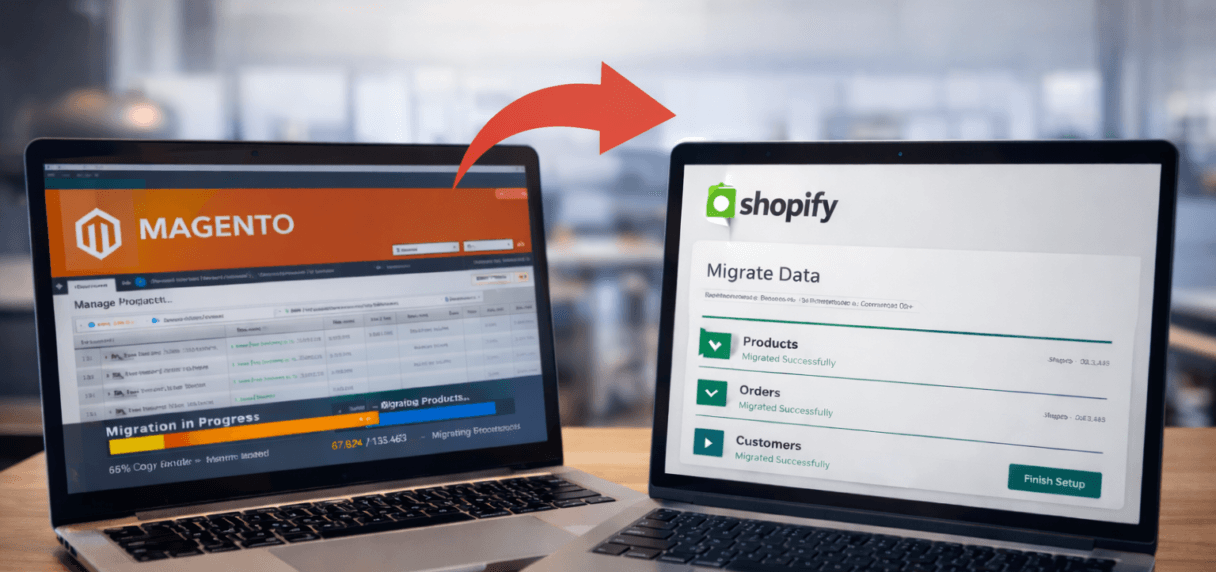
Not all migrations are equal. The originating platform defines the risk profile: SEO continuity, data structure, integrations, and operational stability.
Source Platform
Migration Complexity
Main Risk Areas
Best Fit After Migration
Magento 1 / Open Source
High
SEO equity loss, custom logic rewrite
Brands escaping legacy technical debt
Magento 2 / Adobe Commerce
High
Complex catalogs, ERP/OMS integrations
Mid-market and enterprise operations
WooCommerce
Medium
Plugin replacements, URL restructuring
Brands needing stability and cleaner architecture
BigCommerce
Medium
Feature parity, theme rebuild
Teams seeking operational simplicity
Wix / Squarespace
Low–Medium
Content migration, redirect mapping
Brands outgrowing site builders
Etsy / Marketplace
Low (data) / Medium (business)
Customer portability, retention continuity
Creators shifting to owned channel
Important: “Low” does not mean risk-free. It means risks are manageable with a structured migration plan. “High” requires senior technical leadership and clear risk mitigation.
Why We Don’t Publish Migration Prices
Migration scope varies significantly depending on catalog complexity, integrations (ERP, CRM, OMS), subscriptions, internationalization, and SEO preservation requirements. Publishing generic price ranges creates misleading expectations.
Instead, submit your current store URL and platform. We’ll respond within a few business hours with a scoped migration plan, risk overview, and recommended next steps.
Request a Migration Plan
Send your store URL, source platform, and target timeline. We’ll outline risks, execution strategy, and a clear roadmap tailored to your business.